
CFS Registration in India
With the increasing number of container ships moving through Indian ports, pressure on space within the port area keeps rising. A Container Freight Station acts as an alternative location for cargo storage and inspection, so importers and exporters do not have to wait around in a crowded port area. No private organization can operate such a facility without getting permission from the government.
Schedule a Call Back
Why wait? Start now!
Get Support AnytimeWhat is CFS Registration?
CFS Registration is the official approval process that allows an eligible business to establish and operate a Container Freight Station (CFS) in India. A Container Freight Station is a customs-notified facility where imported and exported cargo is stored, examined, consolidated, stuffed, destuffed, and cleared before reaching its final destination or being loaded for international shipment.
Businesses cannot operate a CFS without having the required approvals from the relevant governmental agencies. The process of registration helps to ensure that the planned CFS meets the required standards in terms of land, infrastructure, security, customs operations, technology, and cargo handling. This helps to ensure that the logistics operation will be safe and legal.
The CFS Registration process generally includes project planning, preparation of technical reports, submission of applications, review by the concerned authorities, infrastructure development, inspections, and appointment as a customs custodian before the facility becomes operational.
Obtaining CFS Registration in India enables businesses to operate legally, support customs clearance, improve cargo movement, and contribute to a more efficient import-export supply chain.
What is a Container Freight Station (CFS)?
Before applying for CFS approval in India, it helps to understand what a container freight station actually does and where it fits inside India's shipping and trade network.
A container freight station is a facility away from the port where containers are stored, examined, and cleared by Customs.
It is set up because ports have limited space and cannot keep every container on site while paperwork and inspections are completed. A CFS takes on this load. Importers bring their containers here for storage and Customs checks, and exporters use it to pack and stuff cargo before it travels to the port for loading. In short, a CFS acts as a working extension of the port, just located further inland or in a nearby industrial area.
Role in India's EXIM Supply Chain
Container freight stations relieve the strain at congested ports by providing storage and Customs clearance services outside the harbor, which enables ports to allocate more space for cargo loading and unloading, and ensures that ships can move faster without waiting to get a berth. This is one of the biggest benefits of CFS registration, since it directly supports faster Customs Clearance and better container logistics management. For both importers and exporters, a registered container freight station means improved supply chain efficiency, reduced demurrage costs, and shorter turnaround time. Gradually, CFSs have emerged as an integrated part of Indian trade infrastructure in support of industry centers situated far inland from the coast.
Difference Between a Container Freight Station (CFS) and an Inland Container Depot (ICD)
People often confuse a CFS with an Inland Container Depot, but the two serve different purposes. The table below sets out the main differences.
| Point | Container freight station (CFS) | Inland Container Depot (ICD) |
| Location | Usually close to a port city | Can be far inland, near industrial clusters |
| Main role | Extension of port operations | Acts as a dry port with its own trade documentation |
| Customs station status | Attached to a specific port | Works as an independent Customs station |
| Rail connectivity | Not always required | Usually connected by rail for long-distance cargo movement |
| Typical use | Short-term storage and Customs clearance | Full import-export processing away from the coast |
A CFS supports a nearby port, while an ICD can function almost like its own port for cargo located deep inland. Some businesses need approval for both, depending on where their supply chain operates.
Why is CFS Registration Important?
Setting up a container freight station without CFS approval in India is not an option under Indian Customs law. Registration protects the operator, the government, and every business that depends on the facility.
The following are the major reasons why CFS registration is important:
- CFS registration in India makes the facility legally recognized under the Customs Act, 1962.
- CFS Approval in India turns the site into an authorized extension of the port for Customs officials.
- Container Freight Station approval protects operators from legal and financial risk through defined security and insurance guidelines.
- CFS registration services enable faster Customs Clearance by allowing on-site inspection and cargo declaration.
- Container freight station registration reduces port congestion by shifting cargo handling to approved inland locations.
- CFS Compliance services keep the facility aligned with CBIC Approval and Ministry of Commerce Approval requirements year after year.
Regulatory Framework Governing CFS Registration in India
CFS registration is not controlled by one single law. It sits at the meeting point of Customs law, trade policy and government notifications.
The following laws and regulatory guidelines govern CFS registration in India:
Ministry of Commerce & Industry Guidelines
The Ministry sets the broad policy on where and how CFS facilities can be developed, in line with India's overall trade infrastructure plans.
Customs Act, 1962
This Act gives Customs officers the legal power to designate and supervise a CFS, and it defines the duties of anyone operating one.
CBIC Circulars and Notifications
The Central Board of Indirect Taxes and Customs issues detailed instructions on procedures, bonds, and record-keeping that every CFS must follow.
Inter-Ministerial Committee (IMC)
The IMC reviews new CFS proposals from a trade and infrastructure standpoint before Customs takes the file forward for final approval.
Appointment of Custodian under Section 45
Section 45 of the Customs Act is what formally appoints the CFS operator as custodian of imported goods until they are cleared.
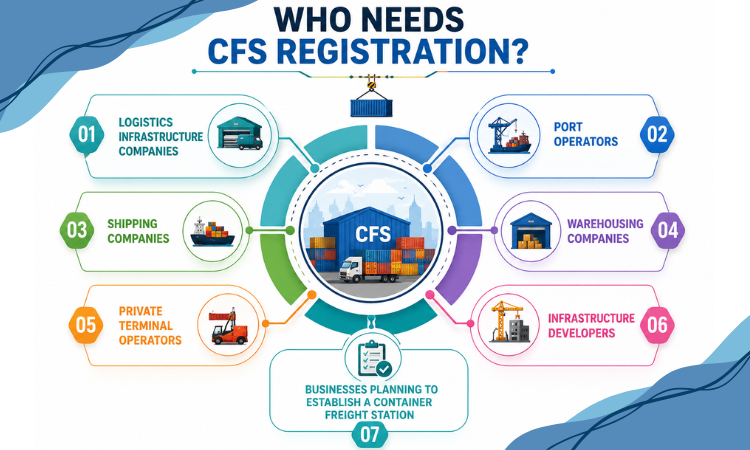
Who needs CFS Registration in India?
Different types of businesses apply for CFS registration depending on what they already do and what they plan to build. The categories below cover most applicants.
The following businesses generally require this:
Logistics Infrastructure Companies
Organizations that already own warehouse, transport, or container yard facilities would enter into CFS operations to provide Customs clearance service as an additional service for their current customers.
Port Operators
Port authorities may establish an associate CFS to deal with the overflow of cargo and ensure that berth areas remain clear for ship berthing and unberthing activities.
Shipping Companies
Shipping companies and their representatives may register a CFS to monitor their container storage and handling processes, without relying on any third-party facilities.
Warehousing Companies
Businesses with existing bonded or general warehousing licences can add CFS Approval in India to handle import cargo under Customs supervision at the same site.
Private Terminal Operators
Private terminal operators use container freight station registration to run a fuller cargo-handling operation, covering storage, examination and delivery under one roof.
Infrastructure Developers
Developers building logistics parks or industrial corridors often include a CFS as part of the project, since it adds long-term value to the site.
Businesses Planning to Establish a Container Freight Station
Any new entrant with suitable land, capital, and a clear feasibility study can apply, even without prior experience in port operations, provided they meet the eligibility conditions.
Eligibility Criteria for Container Freight Station Registration
Before applying, a business should check that it can meet the basic conditions Customs and the IMC look for during review. CFS registration requirements should generally be fulfilled before submitting the application:
Land Requirements
The applicant must hold clear ownership or a long-term lease over land that is large enough and correctly zoned for cargo handling.
Infrastructure Requirements
The site must be able to support a container yard, warehouse space, and Customs examination area, either already built or planned in the project report.
Financial Capability
Applicants need to show they can fund construction, equipment, and working capital, usually through audited financials or bank support letters.
Technical Capability
Some prior experience in logistics, warehousing or port operations helps the application, since it shows the applicant can run a Customs-bonded facility.
Security Infrastructure
A workable plan for boundary walls, CCTV coverage, and access control needs to be part of the proposal from the start.
Traffic Potential and Feasibility Study
The IMC checks whether the proposed location actually has enough cargo volume to justify a new facility, based on a feasibility study submitted with the application.
Infrastructure Requirements for Setting up a CFS
Infrastructure is often the deciding factor in approval, because Customs will not hand over cargo custody to a site that cannot store and secure it properly.
A container freight station should generally include the following infrastructure facilities:
- Container Yard: A paved, well-drained area large enough to stack containers safely without blocking movement lanes.
- Warehousing Facilities: An enclosed facility for cargoes that require shielding from the elements and/or require a bonded, secure facility for their handling.
- Customs Examination Area: A dedicated space where Customs officers can open, inspect, and reseal containers under proper supervision.
- Security Infrastructure: Facilities for fencing around the perimeter, 24-hour CCTV, and a manned entry point.
- IT Infrastructure: Systems that connect to Customs' electronic data interchange so cargo status can be tracked and reported digitally.
- Weighbridge and Scanning Facilities: Facilities for weighing the containers and, when necessary, scanning the cargo without having to open each one.
- Internal Roads and Truck Parking: Roads wide enough for container trucks to move and turn, plus parking that does not spill onto public roads.
Documents Required for CFS Registration
Accurate, complete paperwork is what keeps a CFS registration application moving without avoidable delays or repeated queries from Customs. The following documents are generally required while applying for CFS registration:
Company Incorporation Documents
Certificate of incorporation, PAN, and constitution documents prove the applicant is a legally recognized business entity.
Land Ownership Documents
Sale deed, lease agreement, or title documents issued by the local land authority confirm the applicant's right to use the site.
Feasibility Report
This report, usually prepared by the applicant's consultant, shows expected cargo volume and justifies why the location needs a CFS.
Detailed Project Report (DPR)
The DPR lays out construction plans, cost estimates, and a project timeline, and the applicant issues it with technical input from engineers.
Financial Documents
Audited balance sheets, bank statements, and net worth certificates from a chartered accountant show the applicant can fund the project.
Site Layout and Infrastructure Plans
Architectural drawings of the yard, warehouse and examination area, prepared by a licensed architect or engineer, back up the DPR.
Security Plan
A written plan covering fencing, CCTV placement and access control, prepared in line with Customs security guidelines.
Statutory Registrations
GST registration, IEC code, and any state-level trade licences confirm the business is compliant on other fronts as well.
Undertakings and Declarations
The applicant submits signed undertakings confirming compliance with Customs rules as part of the final application package.
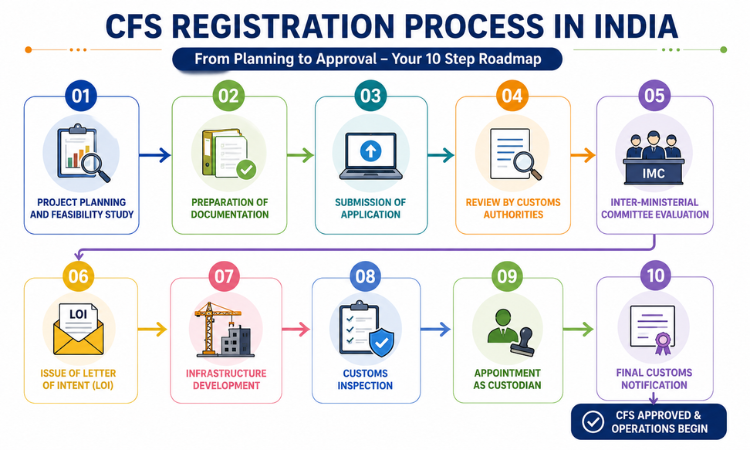
What is CFS Registration Process in India?
CFS registration follows a defined sequence, moving from planning through construction to final Customs notification. Skipping a step usually means starting that stage again. The container freight station registration process generally includes the following steps:
Step 1: Project Planning and Feasibility Study
The applicant studies cargo demand in the area and confirms the site is commercially viable.
Step 2: Preparation of Documentation
Land papers, financial records, the DPR and security plan are compiled into a single application file.
Step 3: Submission of Application
The full dossier is submitted to the jurisdictional Commissioner of Customs for an initial review.
Step 4: Review by Customs Authorities
Customs will examine the dossier and raise queries or clarify sites prior to forwarding the dossier.
Step 5: Inter-Ministerial Committee Evaluation
IMC evaluates the traffic prospects and feasibility and makes a note of their recommendations regarding the application.
Step 6: Issue of Letter of Intent (LoI)
Once satisfied, the Ministry issues a Letter of Intent, giving the applicant conditional approval to proceed.
Step 7: Infrastructure Development
The applicant will develop infrastructure such as a yard, warehouse, examination place and security facilities based on the approved DPR and security dossier.
Step 8: Customs Inspection
Customs officials inspect the completed facility to ensure that the construction and security requirements are met.
Step 9: Appointment as Custodian
Once the inspection is cleared, the applicant is formally appointed custodian of goods under Section 45.
Step 10: Final Customs Notification
Customs issues the final notification declaring the site an approved CFS, after which operations can begin.
Planning a CFS Facility?
Developing a non-compliant Detailed Project Report (DPR) is the #1 reason the Inter-Ministerial Committee (IMC) rejects applications.
[Schedule a DPR & Site Feasibility Assessment with Our Consultants]
Timeline for CFS Registration
The overall timeline for CFS registration depends on how quickly documents are ready, how fast Customs reviews the file, and how long construction takes. Actual timelines may differ from project to project.
- Application Review: Initial scrutiny by Customs typically takes a few weeks, depending on how complete the submitted file is.
- IMC Approval: The Inter-Ministerial Committee usually meets periodically, so this stage can add several weeks to the schedule.
- Infrastructure Development: Construction is normally the longest stage, often running into months depending on the scale of the site.
- Customs Inspection: A site visit is scheduled once construction is complete, and this can be arranged fairly quickly if documentation is ready.
- Final Operational Approval: The final notification follows soon after a successful inspection, allowing the CFS to start receiving cargo.
Cost Factors and Fees for CFS Registration
The total investment for CFS registration depends on land cost, construction scale, and the compliance systems a business chooses to build. The total cost generally includes the following components:
- Government Charges: Fees paid for application processing, inspections, and the final Customs notification.
- Infrastructure Investment: Construction of the yard, warehouse, examination area, roads and security systems, which usually forms the largest share of cost.
- Customs Bond and Bank Guarantee: A financial guarantee that assures Customs the operator can cover any duty liability on cargo under its custody.
- Cost Recovery Charges: Payments made to Customs to cover the cost of posting officers at the facility for inspection duties.
- Consultancy Charges: Fees paid to a registration consultant for documentation, liaison and project support through the approval process.
- Other Operational Expenses: Ongoing costs such as staffing, insurance, utilities and equipment maintenance once the CFS is running.
Annual Compliance Requirements for CFS Operators
Getting container freight station approval is only the starting point. Operators must keep meeting Customs and other regulatory requirements every year to keep the facility running.
The following compliance requirements generally apply after obtaining container freight station registration:
- Periodic Reporting: Regular reports on cargo volume, storage and clearance activity must be filed with Customs.
- Customs Compliance: Operators must keep following the bonding, record-keeping and cargo-handling rules set out under the Customs Act.
- Cost Recovery Payments: Ongoing payments toward the cost of Customs staff posted at the facility must be made on schedule.
- Infrastructure Maintenance: Yards, warehouses and security systems must be kept in working order, matching the approved site plan.
- Environmental Compliance: Waste handling, drainage and pollution control measures must meet the standards set by local environmental authorities.
- Fire and Safety Compliance: Fire-fighting equipment, safety drills and clearances from the local fire department need to stay current.
- Renewal Requirements: Certain licences and approvals linked to the CFS need periodic renewal to avoid a lapse in operating status.
Common Challenges in CFS Registration
Many businesses face avoidable delays during CFS registration because of gaps in planning or paperwork. Knowing these challenges in advance makes the process smoother.
The following are the most common challenges faced during CFS registration:
- Land Availability Issues: Finding land that is the right size, correctly zoned, and close enough to a port can take longer than expected. A consultant can help identify suitable sites early and check zoning before the applicant commits to a purchase or lease.
- Infrastructure Compliance: The applicant fails to plan his yard or security facilities appropriately, and ends up revising the whole process after an inspection. Expert advice on the DPR will help him build infrastructure that is compliant with Customs requirements.
- Documentation Errors: Missing signature, inconsistencies in numbers or financial documents are the common cause of rejection of the file. The consultant will go through all documents to avoid such mistakes.
- Delays in Government Approvals: IMC and Customs meetings do not take place according to a certain program. The consultant will provide regular liaison to keep the file progressing rather than letting it remain idle.
- Financial Planning Challenges: A firm may misestimate the working capital necessary, along with the cost of construction of the building. Proper financial planning at the DPR stage helps to avoid this mistake.
- Customs Observations: In site inspection, some observations may be noted, which may need to be corrected before the final approval. With a consultant who knows the expectations of Customs, one can avoid such observations.
Why Professional Assistance is Important for CFS Registration?
CFS registration involves land law, customs procedures and infrastructure planning at the same time. Professional guidance helps a business move through this without costly missteps.
Professional consultants generally provide the following support during container freight station registration:
Accurate Documentation: Every document is checked against current Customs requirements before it reaches an officer's desk.
Regulatory Compliance: The consultant monitors any updates to CBIC circulars and notifications to ensure that the application is compliant with the latest guidelines.
Faster Government Approvals: Ongoing follow-ups to the Customs & IMC avoid a backlog of the file.
Reduced Risk of Application Rejection: Careful review of eligibility and infrastructure plans lowers the chance of a rejected or delayed file.
End-to-End Project Coordination: From feasibility study to final notification, one team manages the project instead of the applicant coordinating several vendors alone.
Why Corpseed?
CFS Registration in India requires several approvals, paperwork, technical planning, and constant coordination with the regulatory body. Corpseed offers professional assistance for the entire process of registration in order to help businesses successfully complete the process.
Businesses choose Corpseed for the following reasons:
- Complete Registration Support: Assistance from project planning and feasibility assessment to final approval and post-registration compliance.
- Expert Documentation: Preparation and review of applications, DPRs, project reports, declarations, and supporting documents to reduce errors and delays.
- Regulatory Guidance: Help in identifying relevant laws, regulations and other requirements to be met during the registration process.
- Coordination with Authorities: Assistance in managing communications and procedural requirements with the relevant government departments involved in CFS approval.
- Infrastructure Compliance Advisory: Guidance to help businesses align their facilities with prescribed infrastructure, security, and operational standards.
- Customs Compliance Support: Assistance in meeting customs-related obligations and fulfilling requirements for appointment as a customs custodian.
- Post-Registration Compliance: Continuous assistance in fulfilling the regulatory requirements and compliance needs even after the process is approved.
- Dedicated Compliance Experts: A team of experienced professionals providing timely guidance, practical solutions, and personalized support throughout the project.
Corpseed, with its systematic methodology and regulatory experience, can help in making the Container Freight Station registration process simple and efficient for businesses.
Get Expert Assistance for CFS Registration in India.
CFS registration in India brings together land planning, Customs law, and infrastructure development into one long approval process. Businesses that plan early, prepare accurate documents, and build the right infrastructure tend to clear this process with fewer delays and fewer surprises during inspection.
Corpseed can support businesses through all phases of the container freight station Registration process. The Corpseed team assists in carrying out feasibility analysis, preparing the Detailed Project Report (DPR), preparing CFS registration Documents, liaising with Customs and the Inter-Ministerial Committee (IMC), and getting sites ready for Customs inspection. Once the CFS gets approved and receives the final Customs Notification, we assist you in managing your Annual Compliance for CFS activities, including CFS Compliance Services and renewals, in order to maintain the smooth operation of your container freight station.
If you are planning to set up a container freight station, or need help pushing an existing application forward, talk to the Corpseed team today. We can review your project and outline a clear path to approval.
Connect With Corpseed
Connect with the Corpseed team to discuss your requirements at IVR: 7558640644 or hello@corpseed.com. It takes 20–25 minutes to discuss the requirement.
Dedicated Manager
Once you discuss the requirement, we will align a dedicated Account Manager to understand your business needs and assist throughout the process.
Real Time Update
Track the progress of your application and always know what’s in progress and what’s done.
Job Completed
Once the job is completed, you will receive registrations & certifications directly to your email ID and at your doorstep.
Frequently Asked Questions
Quick answers to common questions about this service.
What is CFS in shipping?
A CFS, or container freight station, is a facility where import and export cargo is stored, examined, and cleared by Customs.
What is the full form of CFS in logistics?
CFS stands for container freight station, a Customs-approved facility that handles cargo storage, stuffing, and clearance away from the port.
Who approves CFS registration in India?
The Ministry of Commerce, CBIC, and the jurisdictional Commissioner of Customs jointly review and approve container freight station registration applications in India.
How do I get a CFS licence in India?
It requires submission of a feasibility report, land papers, finance reports, and a project report, followed by IMC clearance and Customs inspection.
How long does container freight station registration take in India?
Depending on projects, it normally takes several months for application processing, IMC approval, and infrastructure construction.
What is the cost of CFS registration in India?
Total cost depends on land, infrastructure investment, Customs bond, cost recovery charges, and consultancy fees, and varies project to project.
What is the difference between CFS and ICD?
A CFS supports a nearby port and handles storage and clearance, while an ICD works as an independent inland Customs station.
Who needs CFS registration?
Logistics companies, warehousing firms, port operators, shipping lines, and infrastructure developers planning cargo-handling facilities need CFS registration.
What is the minimum land requirement for a CFS?
Land size requirements vary by location and project scale and are assessed during the feasibility study submitted with the application.
What is a CFS custodian under Customs law?
A custodian is the CFS operator formally appointed under Section 45 of the Customs Act to hold goods until Customs clearance.
Is CFS registration renewed annually?
CFS approval stays valid as long as the operator meets ongoing Customs compliance, reporting, and infrastructure maintenance requirements each year.
What happens if a CFS operator misses compliance requirements?
Non-compliance can lead to penalties, suspension of custodian status, or cancellation of the CFS registration by Customs authorities.
Need help?
Talk to an Expert
Get free guidance on the right service, improved documents & timeline.






















