
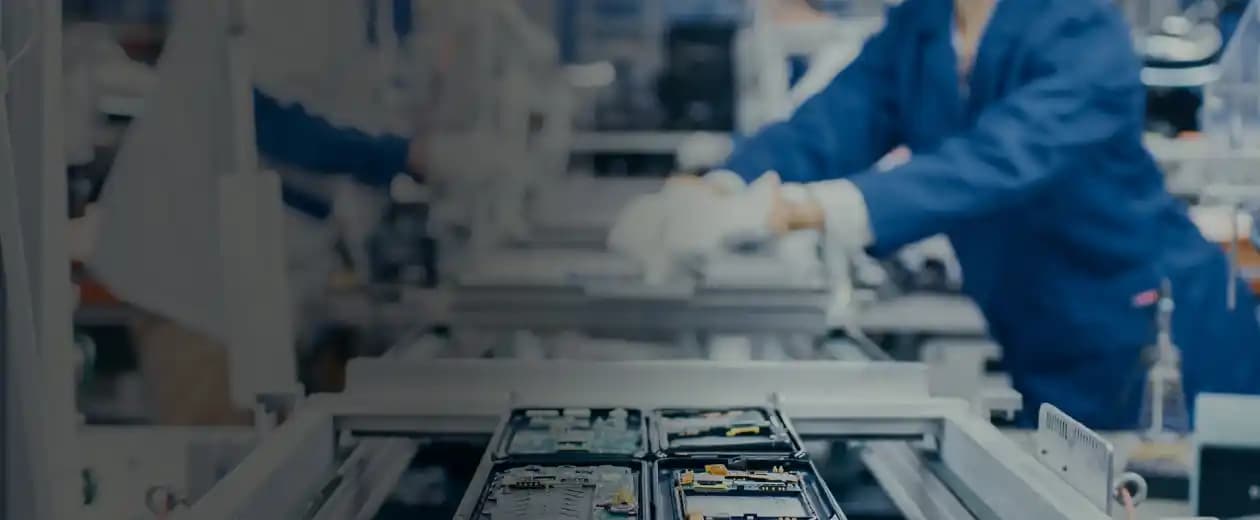
Electronic Product Manufacturing
The process of electronic manufacturing in production is the methodology that manufacturers use to turn ideas from design concepts into actual electronic products. The stages include designing, sourcing, assembling, testing, enclosure manufacturing, quality control, and packaging of the products.

Schedule a Call Back
Businesses we've worked with in electronics manufacturing
Showing 324 clients- Clients include
- Deki Electronics · Shindengen India · Alogic Electronics India · Lianchuang Electronic India · Smiths Detection Systems · Syrma SGS Technology · DS Connectors and Cables India · Enertech UPS · Hayakawa Electronics India · Advantech Industrial Computing India · El Sewedy Electrometer India · Power-One Micro Systems · Stmd Semiconductor · Envoys Electronics · Khaitan Winding Wire · NI Systems (India) · Puls Power India · Shivalik Bimetal Controls · Aten Advance · Comap India · Consilium Safety India · Encardio-Rite Electronics · NEC Wire & Cables · TDK India · +21 more























Industries
Recycling & Waste Management
Recycling is an essential part of waste management. It helps to conserve natural resources, reduce landfill waste, conserve energy, and crea...
KNOW MORE ›Trading Business
Trade of a business reflects the value of services exchanged between domestic and foreign economic members, including the value of services ...
KNOW MORE ›Chemicals
There has been a global shift towards Asia as the world’s chemical manufacturing hub lately. The future of the chemical industry in India de...
KNOW MORE ›How to Setup Electronic Product Manufacturing Industry in India
Electronic product manufacturing is a dynamic industrial process that involves the design, development, production, and assembly of electronic devices and components. This industry has proven to be relatively vital in modern society, with an appreciable level of innovation and contribution to the technology development logistically. It has been one of the sectors placed importantly in global economic development because of its huge impact. Notable industries falling under the electronic product manufacturing sector include consumer electronics, telecommunications, automotive electronics, industrial electronics, and medical devices.
The electronic product manufacturing industry is the cornerstone of technological advancement and essentially serves the purpose of economic growth. It encompasses a wide-range of products and applications, propelled by continuous innovation and dynamically changing consumer requirements. Growth of the industry shall be sustainable despite component shortages, and the wave of regulatory compliance, through riding on trends like miniaturization, sustainability, and rising IoT. All this can only be ensured through electronic product manufacturers who can ensure process efficiency, repeatability, and competence in today's dynamically altered environment, assisted with advanced manufacturing processes, automation, and AI.
Key Segments of Electronic Product Manufacturing Sector in India
- Consumer Electronics: This category includes all consumer electronic devices, such as smartphones, laptops, tablets, televisions, and wearable devices. Innovation occurs exponentially in such a market, with manufacturers constantly releasing new features and technologies for their consumers.
- Telecommunications: Industry production businesses in the sector comprise modules and infrastructure for communication networks, which can be shown to encompass mobile phones, routers, switches, and base stations. The rollouts of 5G technologies are one of the principal drivers of growth in this segment.
- Automotive Electronics: These are the electronic systems used in vehicles, such as infotainment, advanced driver-assistance, the engine control unit of a vehicle, and a battery management system of electric vehicles. The shift toward electric and autonomous vehicles is catalyzing innovation in automotive electronics.
- Industrial Electronics: These are products developed for the use of control systems, sensors, and automation equipment in manufacturing, energy, and other industrial applications. The adoption of Industry 4.0 technologies is driving growth in this sector.
- Medical Devices: Manufactures of electronics used in medicine, more commonly known as diagnostic equipment, monitoring systems, and therapeutic devices. This medical technology is in higher demand because it will suit the elderly population and with a more cautious perspective on health and wellness.
Manufacturing Processes of Electronic Product Manufacturing Sector in India
Design and Prototyping: The process begins with electronic product design, including schematic capture, component selection, and prototyping. Through advanced software tools and simulation technology, it is ensured that the design is optimal for performance and manufacturability.
Printed Circuit Board (PCB) Manufacturing: A PCB is at the heart of most electrical designs. This process involves creating the board layout, etching away copper layers, drilling holes for leads and other components, and applying solder masks and silkscreens.
Component Sourcing and Assembly: Electronic components such as resistors, capacitors, ICs, and connectors are purchased. These are then installed onto the PCBs with the use of automatic machinery, either using surface mount technology (SMT) or through-hole technology (THT).
Testing and Quality Control: The production of electronic goods goes through testing stages to check their reliability and functioning. This involves automated optical inspection (AOI), in-circuit testing (ICT), and functional testing.
Final Assembly and Packaging: Assembled PCBs are embedded in enclosures, and other components are added, such as displays, batteries, and connectors. The final products are then packed and distributed.
Industry Trends of Electronic Product Manufacturing Industry in India
- Smart and connected devices: One of the current trends is the rise of smart and connected devices. This includes everything from smartphones, smartwatches, smart home appliances, and IoT devices to a seamless connection and integration of devices that consumers prefer in their digital ecosystem.
- Artificial intelligence integration: AI has been a major emerging force in the development of consumer electronics. There is an ever-increasing prevalence of AI-powered features and voice assistants, which in turn creates possibilities for personalized user experiences, improved voice recognition, and intelligent automation. Such include virtual assistants, smart speakers, and home automation.
- AR/VR: Augmented reality technologies are fast-tracking their way through to consumer electronics. Virtual reality headsets and AR apps show a rapidly growing interest in immersive gaming experiences. On the other hand, industries such as healthcare, education, and entertainment are looking at the potential of AR/VR applications.
- Wearable technology: After a really slow start, wearable devices are now ramping up. With each passing day, people tend to incorporate wearables more and more into self-health, fitness management, activity tracking, notification, and other on-the-go information reputedly personalized to owners' needs.
- 5G Connectivity: 5G represents the future with speeds that are always higher, better reliability in wireless connections, and opens up a world of possibilities relevant to consumer electronics. 5G shall make enhanced mobile experiences possible, support real-time streaming, and power IoT devices, while also driving innovation in autonomous vehicles and smart cities.
- Sustainability and eco-friendlines: environmental consciousness drives consumer electronics trends. An increasing number of consumers seek eco-friendly and energy-efficient products, inducing manufacturers to adopt sustainable practices, use recyclable materials, and reduce waste.
- Advanced display technologies: Display technology continues to revolutionize the visual experience. Vibrant colors, a high-contrast ratio, and a slim profile increase the popularity of OLED and QLED displays on smartphones, TVs, and monitors. Then, foldable displays come into focus, allowing a new level of innovation in form factors.
- E-commerce and direct consumer selling: E-commerce has changed the game for the consumer electronics industry. Now, products can be made accessible to consumers across the board through an increasing number of direct-to-consumer sales models.
Challenges of Electronic Product Industry in India
- Shortages of Components: Periodic shortages of key components, such as semiconductors, can disrupt production schedules and increase costs.
- Regulatory Compliance: The manufacturer must release products through a maze of regulations and standards, covering areas, such as safety, the environment, and trade compliance.
- IP Protection: IP protection is a serious concern for manufacturers operating in the extremely competitive and globalized market. Therefore, strong legal and security measures need to be adopted to protect IP.
- Technological Obsolescence: In a rapidly changing technological environment, products tend to become obsolete within no time; hence, innovation and adaptation must be continuous.
Eco-friendly activities
The recent trends and forecasts in manufacturing indicate a paradigm shift in consumer behavior. Businesses have realized the potential impact of their products on the environment; hence, there is a growing effort to adopt sustainability in the production of electronic products.
The objective of many businesses is to become a green manufacturing company. Many businesses follow several environmentally friendly methods. Some assembly plants at present generate energy through solar power. This is such an energy that comes from a renewable resource. Due to the application of solar energy in the manufacturing processes, emissions can be reduced by those assembly plants which in turn saves energy so that the manufacturing process would become clean.
Manufacturing of electronics is an integral part of the economy of the world. Millions are employed, and simultaneously, numerous appliances that we utilize are delivered to the consumer. The effect of them on our climate should be known to us as consumers. We can all play a role in making sure the process is eco-friendly.
Why to choose Corpseed?
Corpseed offers a holistic suite of services to support electronic product manufacturers in India. By providing regulatory guidance, ensuring compliance, optimizing supply chains, protecting intellectual property, and offering financial and market insights, Corpseed helps companies navigate the complexities of the electronic manufacturing industry, enabling them to focus on innovation and growth
Enquiry Now
Electronic Product Manufacturing
Enquiry Now
Electronic Product Manufacturing
Industries We Cater To
Manufacturing
The manufacturing industry comprises businesses engaged in producing tangible goods Advances in automation, collaboration, innovation, and other areas also contribute to improving manufacturing quality and efficiency using AI and machine learning.
KNOW MOREFrequently Asked Questions
Quick answers to common questions about this service.
What is the scope of the electronic product manufacturing industry?
It means designing, manufacturing, and assembling electronic devices and components that go into consumer electronics, telecommunication, the automobile industry, health, and industrial applications. The scope ranges from smartphones and laptops to industrial control systems and medical devices.
What are the major regulatory compliances for manufacturing electronic products?
There are several regulatory compliances that a manufacturer has to adhere to, which include:
- BIS Certification - Products should meet Indian standards that are set by the Bureau of Indian Standards.
- RoHS Compliance - Restriction of Hazardous Substances in electronic and electrical equipment.
- WEEE Directive - Electronic waste disposal and recycling system.
- ISO Certifications - like ISO 9001 for Quality Management and ISO 14001 for Environment Management.
What are the steps to establish an electronic manufacturing unit?
Key steps involve -
- Market Research: Extensive research in the market to understand demand and competition.
- Business Plan: Preparation of a business plan spelling out objectives, strategies, and financial projections.
- Licensing and Permissions: Obtaining all licenses and permissions, including environmental clearances, etc., and registration of the business.
- Infrastructure Development: Physical infrastructure in terms of manufacturing facilities and machinery.
- Hiring and Training: The latest skilled manpower recruitment is done along with the required training.
- Production and Quality Control: The initiation of production lines followed by quality control accordingly.
What are the Govt. of India's support schemes for electronic manufacturing in India?
The central government is giving several incentives/schemes to boost the local electronic manufacturing industry which include: -
- Make in India: A scheme that aims at inviting investment and promoting local manufacturing.
- Production Linked Incentive Scheme: It provides a financial incentive to increase domestic manufacturing and exports.
- Modified Special Incentive Package Scheme (M-SIPS): This is for capital subsidies in setting up and expanding electronic manufacturing units.
- Electronics Manufacturing Clusters Scheme: Setting up of infrastructure for manufacturing electronics.
What are the major challenges faced by electronic product manufacturers?
Some key challenges include:
- Component Shortages: Global supply chain disruptions result in the shortage of critical components such as semiconductors.
- Regulatory Compliance: Navigating complex and evolving regulatory requirements.
- Technological Obsolescence: Rapid progress leading to frequent updates and replacement of products.
- High Import Dependence: On imported raw materials/components.
- Protection of Intellectual Property: Of Innovations and Proprietary Technologies.
What is the purpose of quality control in electronic manufacturing?
The quality control process ensures that products are manufactured to specified standards, satisfying customer expectations. It consists of:
- Testing and Inspection: In-process at different stages of production to identify any defects.
- Standards to Which Products Must Conform: Ensure conformance to national and international standards.
- Continuous Improvement: Introduce a process of continuous quality improvement and reduction in defect rate.
How is sustainability addressed in electronic manufacturing?
Some of the sustainability practices followed by the electronic manufacturing industry are:
- Eco-friendly Materials: Use recyclable, biodegradable materials.
- Energy-efficient Processes: Introduce energy-saving processes in manufacturing.
- E-waste Management: Develop suitable systems for the proper disposal and recycling of e-waste.
- Compliance with Regulations: In line with environmental regulations and standards, keeping an eye on impact.
What are the future trends in the electronic manufacturing industry?
Future Trends are:
- IoT and Smart Devices: Increasing demand for connected devices with advanced communication capabilities.
- Automation and AI: Enhanced manufacturing efficiency by robotics and AI-driven processes.
- Miniaturization: Development of smaller, more powerful electronic devices.
- 5G Technology: Expansion of 5G infrastructure together with related electronic products.
- Sustainable Manufacturing: Increased focus on eco-friendly production practices and materials.